Anyone who has heard me give my usual talk about Betsy Ross knows that one of the first slides I like to use is of my Colonial Barbie—spotted in the aisles of Toys-R-Us in the mid 1990s, while I was still writing my dissertation on women’s work in the eighteenth-century clothing trades. I was writing about gownmakers in early America and Barbie was holding a quilt square – “close enough,” I thought as I snatched her up. And in time she earned a place in the book that emerged from the dissertation (The Needle’s Eye), her photo accompanying a passage reflecting on the considerable body of mythologies that continue to shape general understandings of early American needlework.
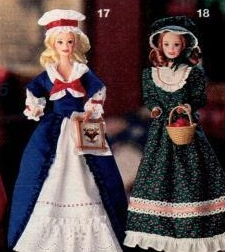
Folks who know me and my Mom also know that there was a lot of Barbie fascination in our home. My Barbie enjoyed a pool, a camper, a sailboat, and many other glamorous accessories. Meanwhile, my Mom in time became a Barbie collector, and shelves filled with the annual Holiday Barbie, Harley Davidson Barbies, and so on.
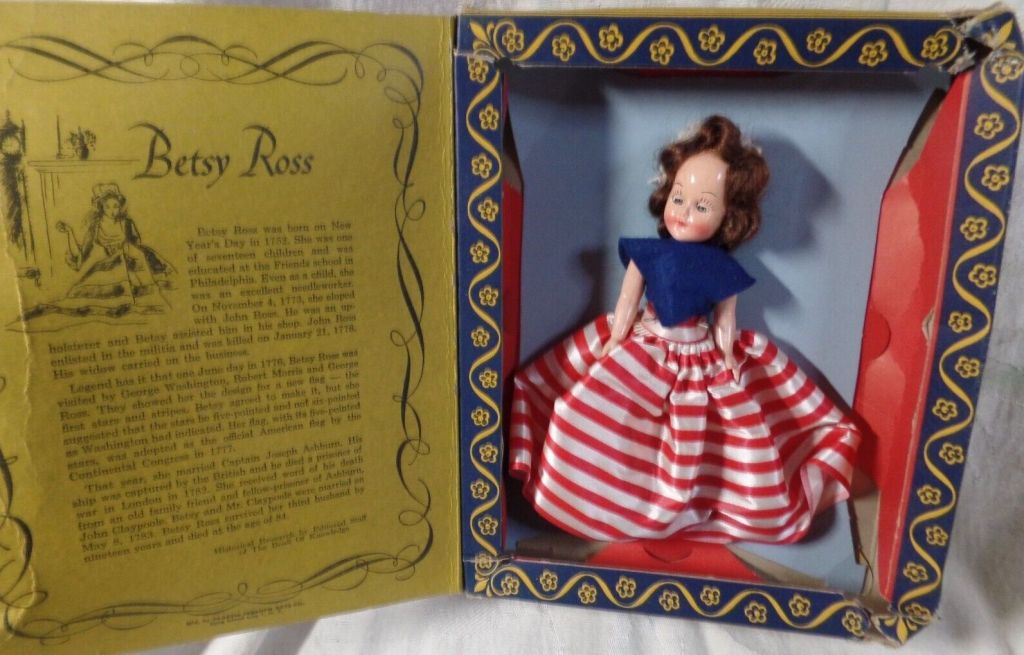
When my next book project turned to the subject of Betsy Ross—whose work as an upholstery seamstress is generally overlooked and misunderstood—the doll continued to help me explain to audiences how popular culture tends to assume that in early America, women’s work in clothing production and repair was ubiquitous and undifferentiated by skill level. I found myself talking, and thinking, a good bit about the doll and what it tells us about popular thinking about early American womanhood.
Years later I received a happy invitation from Hilary Iris Lowe to think further about this subject alongside other authors similarly contemplating cultural meanings of Barbie. She too had spent a lot of time with Barbie, especially through her class on American Icons. Would I care to create a more sustained piece on Mattel’s foray into historical dolls, with a particular focus on material culture?
Of course that was a quick “yes.”
I spent a fun year delving deeply into the “American Stories” series, to which Colonial Barbie belongs. Mattel’s answer to the phenomenon that was the Pleasant Company’s American Girls, the series included eight dolls representing moments in U.S. history, particularly the colonial and pioneer eras, as well as the U.S. Civil War. Two dolls aimed to represent indigenous pasts. Ebay was my friend, as I ordered the dolls I did not yet have – now for research purposes rather than play or as collectibles.
The resulting essay, “Telling American Stories: Mattel and the Material Culture of the US Past,” eventually published in the Canadian Review of American Studies, situated the series in three principle contexts. Close examination of the dolls’ clothes, accoutrements, and accompanying storybooks supports consideration of what the dolls suggest about how Americans “remember” key moments in U.S. history, while contemplation of the moment in which the dolls appeared – the mid 1990s – consider what they might suggest in terms of the “history wars” of that decade. Lastly, the essay places the series in a longer history of doll play, and notes the durable function of dolls as means to communicate to young people values and qualities to be emulated–in this case generosity, caregiving, and community spirit.
I was delighted to receive word this month that the article has been selected for this year’s Ernest Redekop Prize, awarded by the Canadian Association for American Studies for the best essay published in the Review in the previous year. The project was a joy from start to finish, and it’s so delightful that the committee found these Barbies as mesmerizing as I do!


Leave a Reply